Bohemian vs Saxon Switzerland: Differences, Highlights and Can You See Both in One Day?
Bohemian Switzerland (Czechia) or Saxon Switzerland (Germany)? How the two national parks differ, the best sights on each side — Pravčická Gate, the Bastei Bridge, Königstein Fortress — and how to see both in one day from Prague.


Bohemian Switzerland and Saxon Switzerland are the same sandstone landscape — the Elbe Sandstone Mountains — split by the Czech–German border into two national parks. Bohemian Switzerland (Czechia, national park since 2000, 79 km²) is wilder and more forested, with Pravčická Gate and the Kamenice gorges. Saxon Switzerland (Germany, national park since 1990, 93.5 km²) has the big, famous viewpoints: the Bastei Bridge, Königstein Fortress and the Schrammsteine. They are only about 25 km apart, so with a car or a tour you can see the highlights of both in one day from Prague.
I spend most of my working weeks on both sides of this border, so this is the question I get asked most often: "Which one should we visit?" Here's my honest answer.
The short answer
- One day, want the most famous views: do both — Pravčická Gate in the afternoon, the Bastei in the morning. You need a car or a tour.
- One day by public transport: pick one side. From Prague, the Czech side (Hřensko, Pravčická Gate) is quicker to reach; the German side (Bastei, Königstein) is easier to get around by train.
- Longer hikes and fewer people: Bohemian Switzerland, especially the Jetřichovice area.
- Castles, fortresses and panoramas with less walking: Saxon Switzerland.
Side-by-side comparison
| Bohemian Switzerland (Czechia) | Saxon Switzerland (Germany) | |
|---|---|---|
| National park since | 2000 | 1990 |
| Park area | 79 km² | 93.5 km² |
| Highest point in the park | Růžovský vrch, 619 m | Großer Winterberg, 556 m |
| Gateway | Hřensko, Jetřichovice | Bad Schandau, Rathen, Königstein |
| Signature sight | Pravčická Gate | Bastei Bridge |
| Character | forest, deep gorges, quieter trails | open viewpoints, table mountains, more infrastructure |
| Crowds | moderate, busier in summer | the Bastei is very busy at midday |
| Currency | Czech crown (CZK) | euro (EUR) |
| From Prague | ~1 h 45 min – 2 h by car | ~2 h by car or EuroCity train |
Why two "Switzerlands"?
The name has nothing to do with the Alps. In 1766 two Swiss painters, Adrian Zingg and Anton Graff, came to teach at the art academy in Dresden. The rocky Elbe valley reminded them of home, and they called it "Saxon Switzerland". The Czech side became "Bohemian Switzerland" by the same logic. The painters' favourite routes later became the Malerweg (Painters' Way), a 112 km trail in 8 stages through Saxon Switzerland.
Geologically there's no border at all: the whole region is the floor of a sea that covered Central Europe about 90 million years ago, cut into towers, tablelands and canyons by the Elbe and its tributaries.
Highlights of Bohemian Switzerland (Czech side)
- Pravčická Gate — the largest natural sandstone arch in Europe (16 m high, 26.5 m span), with the Falcon's Nest chalet underneath. 125 CZK in 2026.
- Edmund's Gorge and the Wild Gorge — boat rides through the Kamenice canyons, April/June to 1 November.
- Jetřichovice viewpoints — Mariina vyhlídka, Vilemínina stěna and the Šaunštejn rock castle, connected by ladders and stairs. Quieter and great in autumn.
- Hřensko — the village squeezed between rock walls at the lowest point of Czechia (about 115 m above sea level).
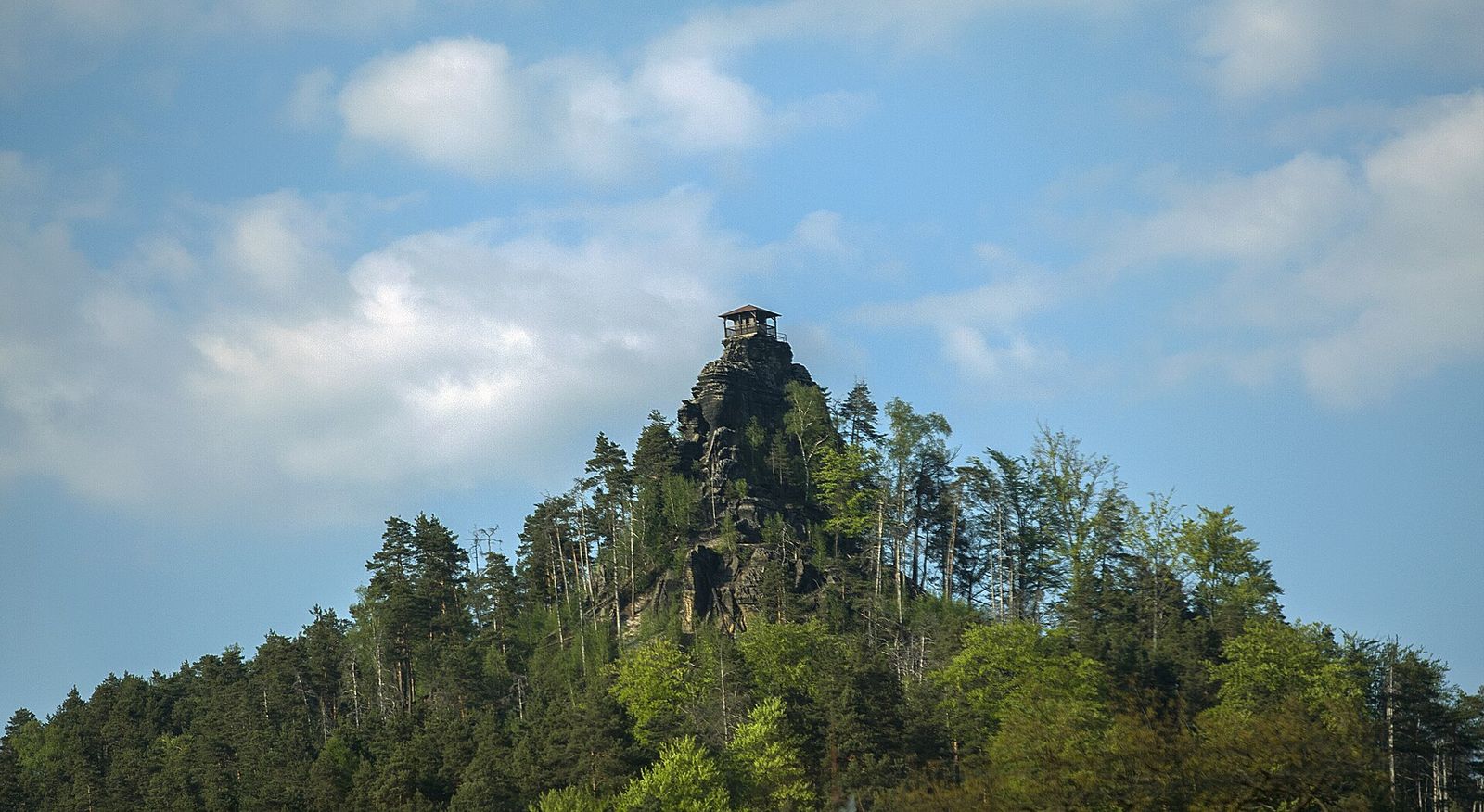 The wooden lookout hut of Mariina vyhlídka on top of a sandstone rock near Jetřichovice
Highlights of Saxon Switzerland (German side)
- Bastei Bridge — the 1851 stone bridge between rock towers 194 m above the Elbe. Free and open 24/7.
- Königstein Fortress (Festung Königstein) — one of the largest hilltop fortresses in Europe, on a table mountain above the Elbe. In 2026 admission is €17 for adults until 1 November and €15 in the winter season (from 2 November), open daily.
- Schrammsteine — a jagged ridge of rock towers above Bad Schandau with one of the best panoramas in the region; a steeper hike with ladders.
- Lilienstein — the table mountain you see from the Bastei, with an easy climb and views of Königstein.
- Kirnitzschtal tram
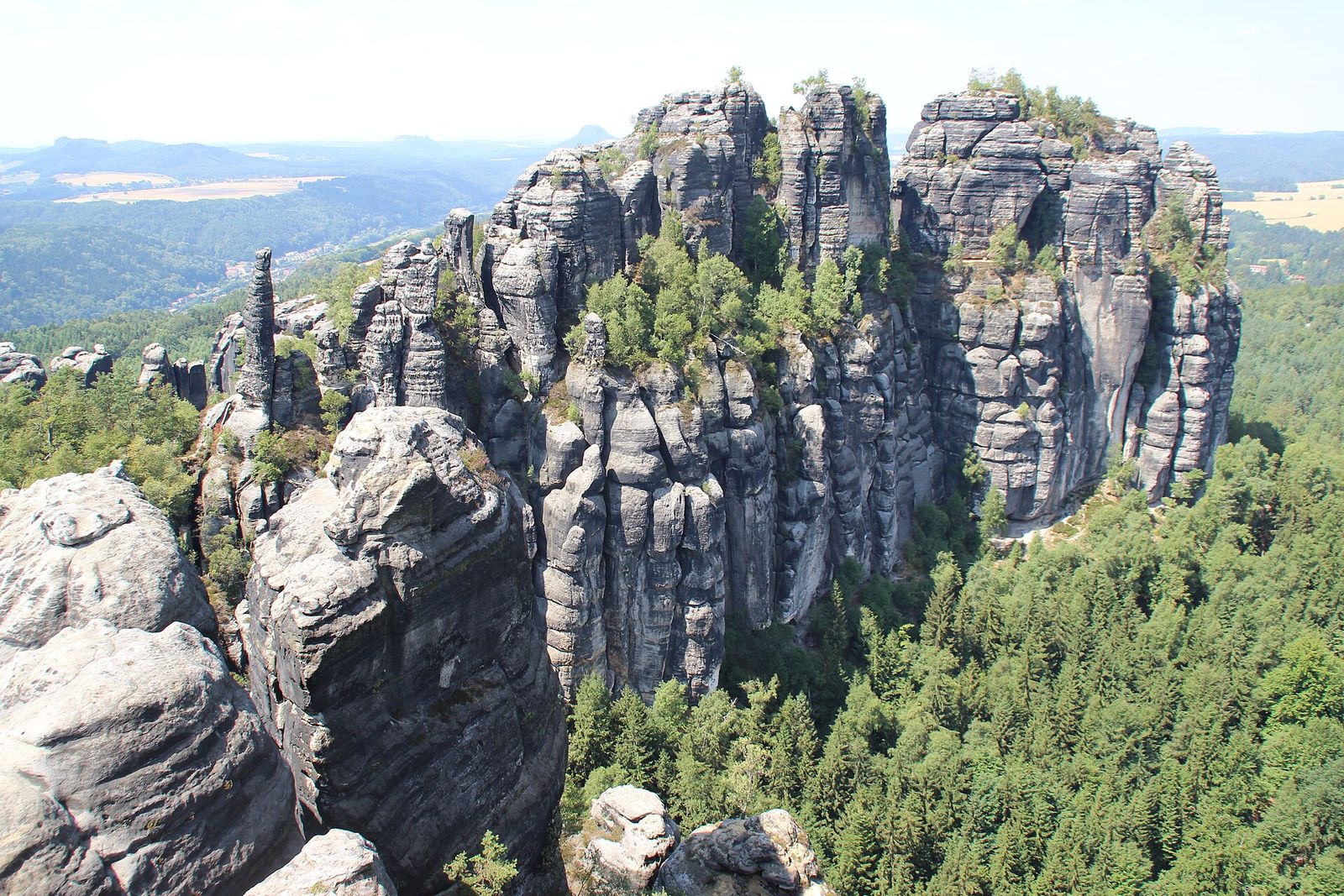 The jagged sandstone towers of the Schrammsteine above the forests of Saxon Switzerland — a historic tram from Bad Schandau up the Kirnitzsch valley to the Lichtenhain waterfall.
Can you see both in one day from Prague?
Yes — but only realistically by car or on a guided tour. The Bastei and Pravčická Gate are about 25 km apart (40 minutes by car), but connecting them by public transport means several trains, a ferry and buses with tight connections.
A day that works:
- 08:00 — leave Prague
- 10:00–11:30 — the Bastei Bridge and viewpoints, before the coach groups arrive
- 12:30 — lunch in Hřensko
- 13:30–16:30 — hike to Pravčická Gate and back
- 18:30 — back in Prague
This is the route of my Bohemian and Saxon Switzerland Tour: up to 7 guests, pickup in central Prague, lunch included, about 8 km of walking in total.
Without a car, I'd choose one side:
- Czech side: train to Děčín, bus 434 to Hřensko, Pravčická Gate and (in season) a gorge boat ride. See How to get from Prague to Bohemian Switzerland.
- German side: EuroCity to Bad Schandau, S-Bahn to Kurort Rathen, ferry and climb to the Bastei; or the Kirnitzschtal tram and the Schrammsteine.
Crossing the border: practical notes
- No border controls (both countries are in the Schengen area), but you're required to carry a passport or national ID card. Random checks do happen.
- Money: crowns on the Czech side, euros in Germany. Cards are widely accepted in Germany; bring some cash in crowns for Pravčická Gate.
- Cross-border day ticket: the Elbe-Labe Ticket covers regional trains, buses and ferries on both sides (420 CZK / €28.50 in 2026), but not EuroCity trains or the journey from Prague.
- Rental cars: tell the rental company you're crossing into Germany.
Frequently asked questions
What is the difference between Bohemian Switzerland and Saxon Switzerland?
They're two halves of the same sandstone landscape. Bohemian Switzerland is the Czech part, a national park since 2000, known for Pravčická Gate and the Kamenice gorges. Saxon Switzerland is the German part, a national park since 1990, known for the Bastei Bridge and Königstein Fortress.
Which is better, Bohemian or Saxon Switzerland?
Neither is "better". Saxon Switzerland has the more famous viewpoints and is easier to get around by train; Bohemian Switzerland is wilder and quieter and has Europe's largest sandstone arch. If you can, see the highlights of both.
Can you visit Bohemian and Saxon Switzerland in one day?
Yes, by car or with a guided tour from Prague. The Bastei Bridge and Pravčická Gate are about 25 km apart, so you can see both in one full day. By public transport it's very hard to combine them.
Do I need a passport to go from Bohemian to Saxon Switzerland?
There are no border checks between Czechia and Germany, but you must carry a valid passport or national ID card.
Is the Bastei Bridge in Bohemian Switzerland?
No. The Bastei Bridge is in Saxon Switzerland, Germany — about 40 minutes by car from Hřensko, the gateway to Bohemian Switzerland.
Why is it called Switzerland?
Two Swiss painters teaching in Dresden in the 1760s, Adrian Zingg and Anton Graff, thought the rocky Elbe valley looked like their homeland. They called it "Saxon Switzerland", and the Czech side became "Bohemian Switzerland".
Photos: Jerzy Strzelecki, CC BY-SA 3.0, via Wikimedia Commons · Geoprofi Lars, CC BY-SA 4.0, via Wikimedia Commons

