Saxon Switzerland: The Complete Guide from Prague and Dresden (2026)
Everything you need to visit Saxon Switzerland National Park — the Bastei Bridge, Königstein Fortress, the Schrammsteine, Kuhstall and Lilienstein, how to get there from Prague by train or car, 2026 prices, current closures and the best one-day itineraries.

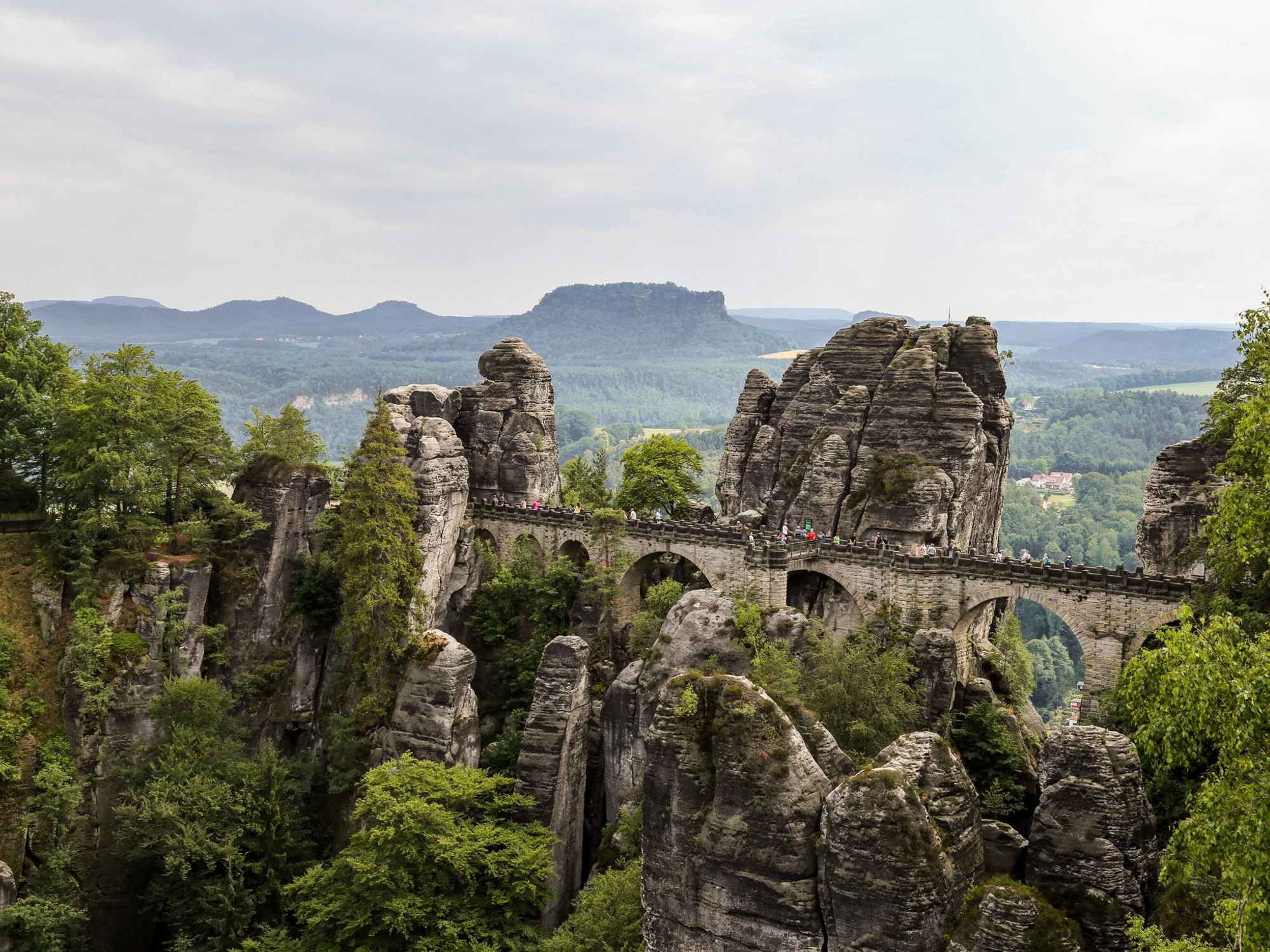
Saxon Switzerland (Sächsische Schweiz) is the German half of the Elbe Sandstone Mountains, between Dresden and the Czech border — a landscape of sandstone towers, table mountains and gorges along the river Elbe. Its core is a 93.5 km² national park, founded in 1990. The highlights are the Bastei Bridge (free, open 24/7), Königstein Fortress (€17 adults until 1 November 2026, €15 in winter), the Schrammsteine ridge and the Kuhstall rock arch. From Prague it's about 1 h 45 min – 2 hours by direct train to Bad Schandau or by car; from Dresden, 30–45 minutes.
I cross into Saxon Switzerland with my groups almost every week, usually for the Bastei Bridge before we head back to Pravčická Gate on the Czech side. This is my guide to the German side as a whole.
Saxon Switzerland at a glance
| Where | Saxony, Germany, along the Elbe between Pirna and the Czech border |
| National park | since 1990, 93.5 km² in two parts (Bastei–Rathen and the hinterland east of Bad Schandau) |
| From Prague | ~1 h 45 min – 2 h by direct train (to Bad Schandau) or car |
| From Dresden | 30–45 min by S-Bahn S1 or car |
| Main bases | Bad Schandau, Kurort Rathen, Königstein |
| Top sights | Bastei Bridge, Königstein Fortress, Schrammsteine, Kuhstall, Lilienstein |
| Currency | euro |
| Best for | viewpoints, day hikes, the Elbe valley by train and boat |
Current closures (autumn 2026)
A storm at the end of July 2026 caused damage around Kurort Rathen. As of late October 2026:
- The Bastei Bridge and the path up from Rathen are open again (since 7 August).
- Neurathen rock castle next to the Bastei bridge stays closed until further notice.
- The Rathen open-air stage (Felsenbühne) is closed for the whole 2026 season.
- Malerweg stages 2, 3 and 5 have detours; the Schindergraben path to Hohnstein is closed.
- The Lichtenhain Waterfall was damaged by heavy rain — don't count on the waterfall being "released".
Check the official updates at saechsische-schweiz.de before you go.
The best things to see
Bastei Bridge
The most visited place in Saxon Switzerland: a 76.5 m stone bridge from 1851 spanning a chain of sandstone towers 194 m above the Elbe, with a viewing platform that opened in 2023. Free and open around the clock. Go before 10:00 or late in the afternoon. Full guide: Bastei Bridge.
Königstein Fortress
One of the largest hilltop fortresses in Europe, on a table mountain 240 m above the Elbe — never captured in its history. Don't miss the 152 m well cut by hand into the sandstone, and the walk along the walls with views over the whole region. In 2026: €17 adults until 1 November, €15 from 2 November; daily 9:00–18:00 (winter 9:00–17:00). Full guide: Königstein Fortress.
Schrammsteine
A jagged ridge of towers above Bad Schandau with one of the finest panoramas in the region. The classic route climbs the Wildschützensteig — a one-way, ascent-only path with ladders and iron steps — to the Schrammsteine viewpoint. The official loop from Ostrau is about 9 km, 3.5 hours. Not for anyone with a fear of heights.
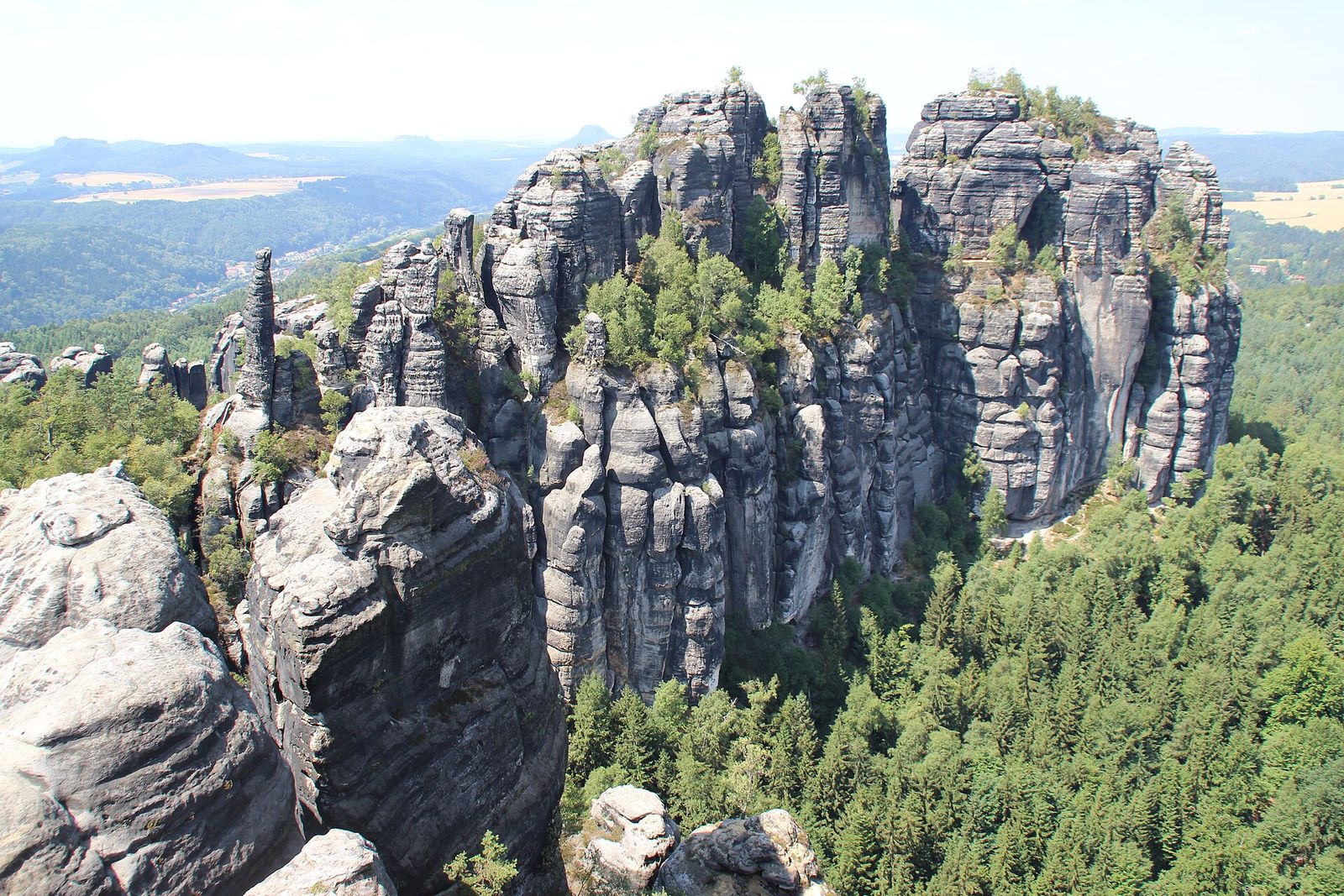 The jagged sandstone towers of the Schrammsteine above the forests of Saxon Switzerland
Kuhstall
The largest natural rock arch in Saxon Switzerland — about 11 m high, 17 m wide and 24 m deep — in the hinterland above the Kirnitzsch valley. A narrow "Heavenly Ladder" (Himmelsleiter) leads up through a crack to a viewpoint on top. Reach it from the Kirnitzschtal tram (Beuthenfall stop) or as a hike from Bad Schandau.
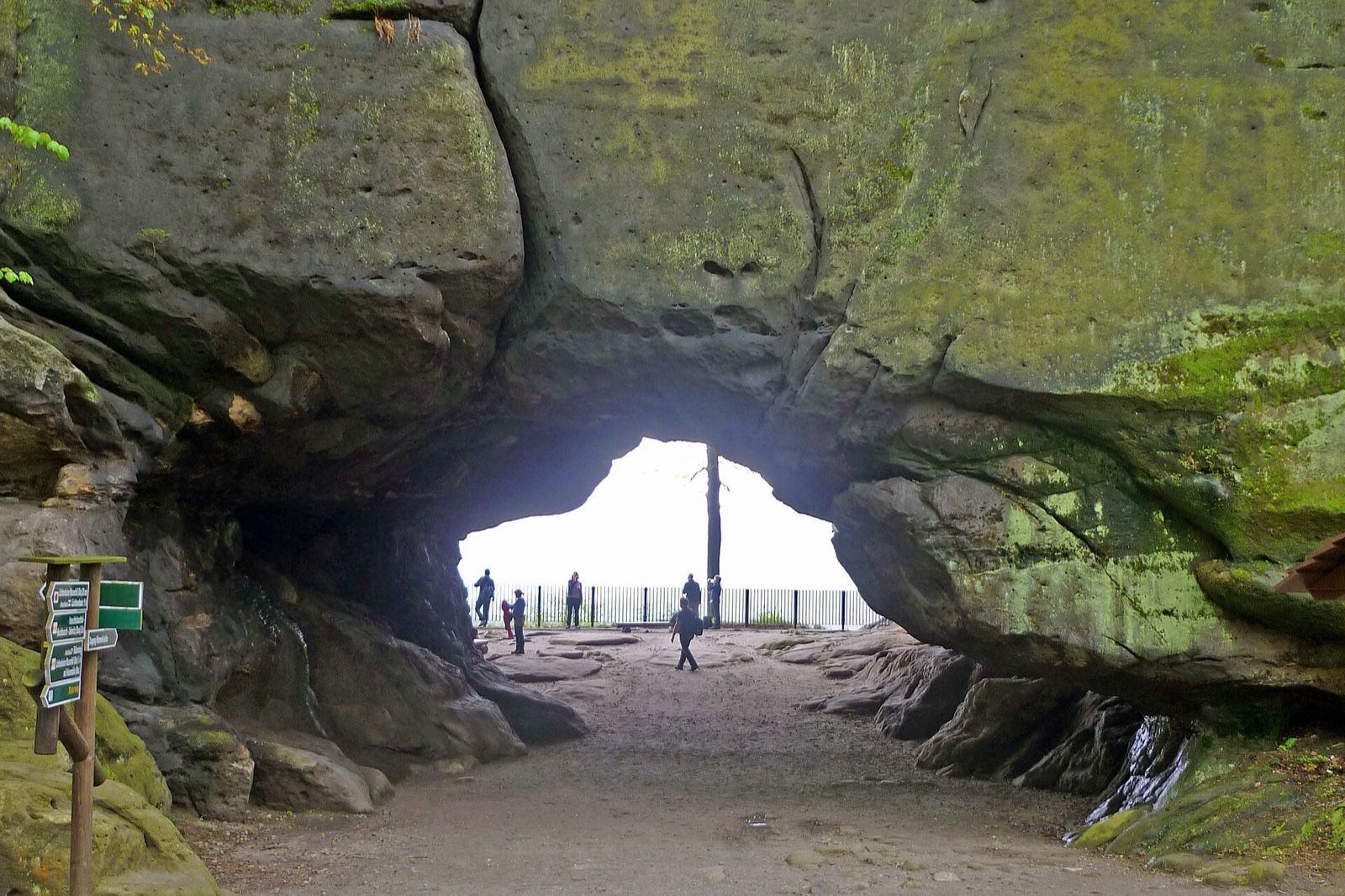 The massive Kuhstall rock arch in Saxon Switzerland framing a viewpoint railing with hikers.
Lilienstein
The table mountain you see from the Bastei, 415 m high and the only one on the right bank of the Elbe. An easy climb of about 30 minutes from the hikers' car park, with views of Königstein Fortress. Great at sunrise.
Kirnitzschtal tram
A historic tram from 1898 running 7.9 km from Bad Schandau up the wooded Kirnitzsch valley to the Lichtenhain Waterfall. In 2026: €7 single, €10 day ticket, €25 family day ticket; every 30 minutes in summer (winter timetable from 2 November).
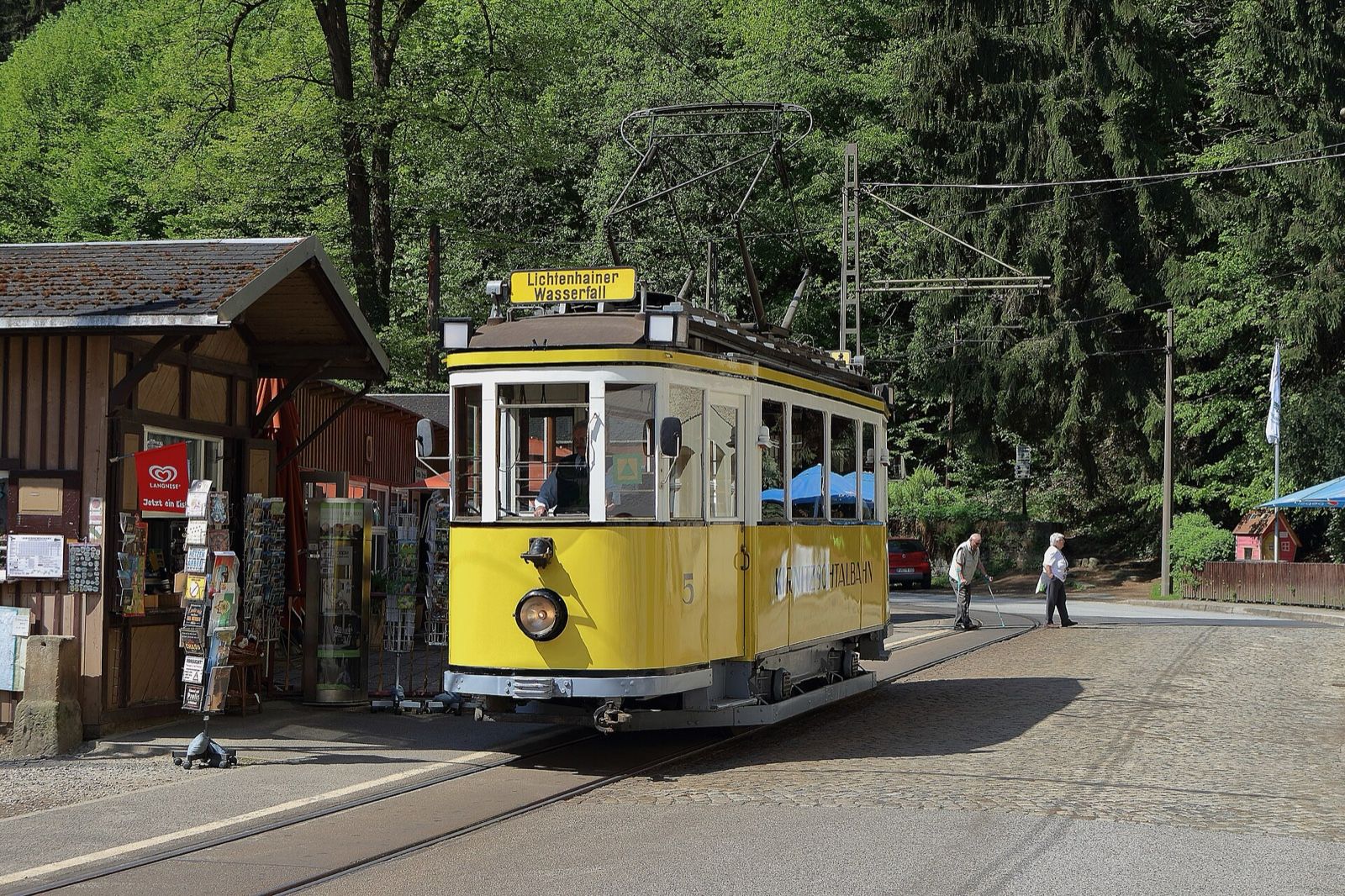 Historic yellow Kirnitzschtalbahn tram number 5 at the Lichtenhainer Wasserfall terminus in the Kirnitzsch valley.
Bad Schandau
The main base for the eastern part of the park: a small spa town on the Elbe with a 50 m Art Nouveau lift from 1904 (€2.50 one way, €3.50 return) up to the Ostrau plateau, the start of the Schrammsteine hikes.
Pfaffenstein
A table mountain near Königstein (434 m) with a ladder climb through the "Needle's Eye" and the Barbarine rock needle — quieter than the Bastei.
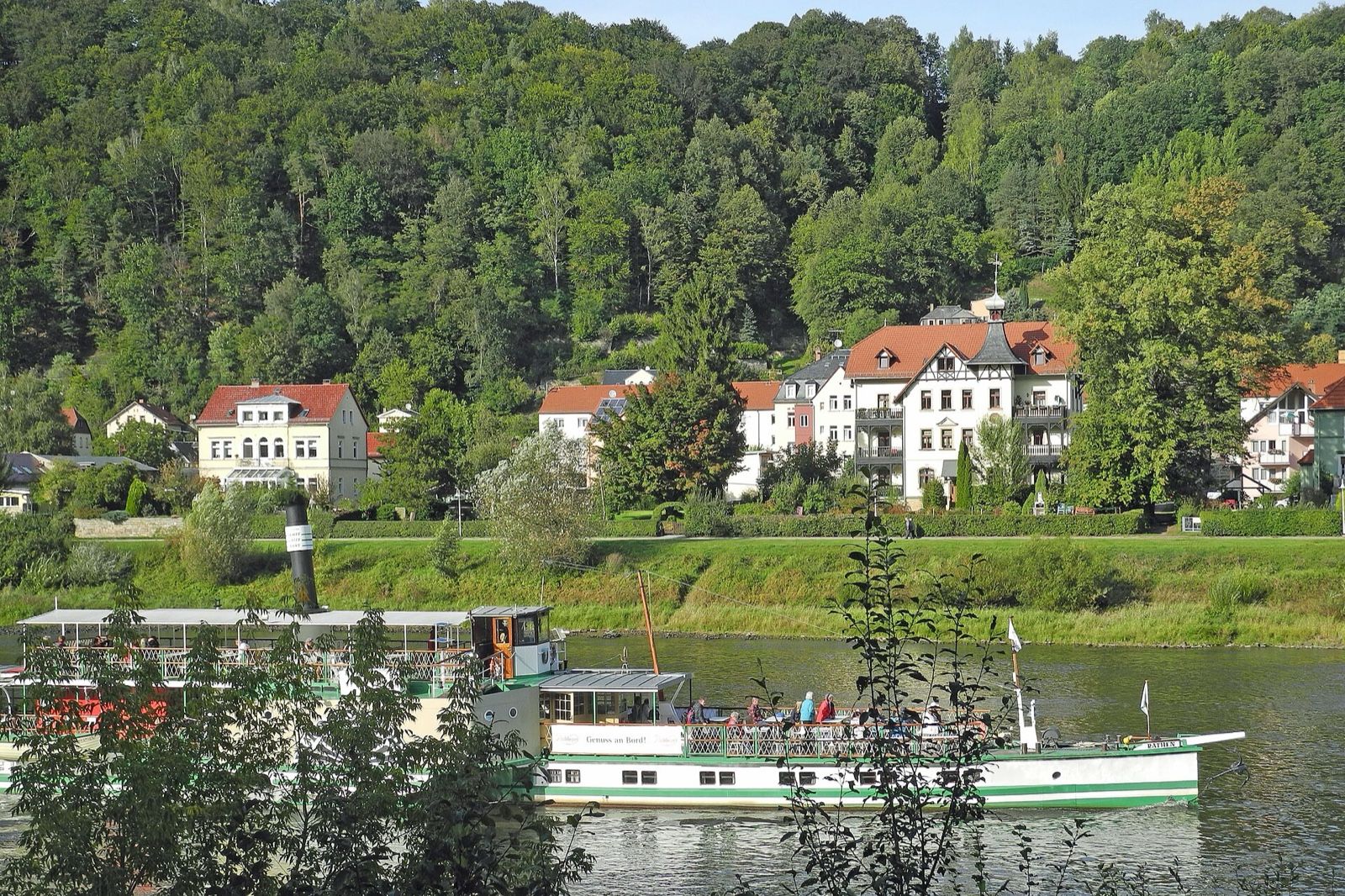 Paddle steamer on the Elbe passing the riverside villas of Bad Schandau below forested hills.
How to get to Saxon Switzerland from Prague
| Option | Time | Good to know |
|---|---|---|
| Direct train | ~1 h 45 min – 2 h | EuroCity and ČD trains from Praha hl. n. to Bad Schandau; the line follows the Elbe gorge (sit on the right going north). |
| S-Bahn S1 | — | From Bad Schandau the S1 runs along the Elbe to Königstein, Kurort Rathen, Stadt Wehlen, Pirna and Dresden. |
| Ferries | — | Rathen (for the Bastei; a small cable ferry with its own fare) and Königstein–Halbestadt (in the VVO tariff). |
| Car | ~1 h 45 min – 2 h | D8 to the border, then the A17 or along the Elbe; no German vignette. Bastei car parks fill up by mid-morning on weekends. |
| Guided day trip | — | My Bohemian and Saxon Switzerland Tour combines the Bastei with Pravčická Gate on the Czech side, with lunch. |
The Elbe-Labe Ticket (€28.50 / 420 CZK in 2026) covers regional trains, the S-Bahn, buses and most ferries on both sides of the border for a day — but not EuroCity trains. See how to get from Prague to Bohemian Switzerland for details.
One-day itineraries from Prague
1. Bastei by train (classic): EC to Bad Schandau → S1 to Kurort Rathen → ferry across the Elbe → climb to the Bastei (30–45 min) → back the same way.
2. Schrammsteine (for hikers): EC to Bad Schandau → historic lift to Ostrau → Schrammsteine loop via the Wildschützensteig (~9 km) → back down to Bad Schandau for the train.
3. Fortress and river: EC to Bad Schandau → S1 to Königstein → Festungsexpress mini train or the walk up → Königstein Fortress → S1 back.
4. Bastei + Pravčická Gate (by car or tour): the Bastei in the morning, then 40 minutes to Hřensko and the hike to Europe's largest sandstone arch. See Bohemian vs Saxon Switzerland.
A climbing heartland
Saxon Switzerland is one of the birthplaces of free climbing. Local gymnasts climbed the Falkenstein in 1864, and in 1910 the Saxon climbing rules were written down: no metal protection drilled for progress, only knotted slings, and no chalk — rules still followed on the area's more than 1,000 climbing summits. You'll see climbers on the towers around the Bastei and the Schrammsteine on most dry days.
When to go
- Spring and autumn are best — fewer people, clear views, morning fog in the Elbe valley.
- Summer is busy, especially at the Bastei on weekends; start early.
- Winter is quiet and often frosty. The Bastei and Königstein are open; some boats and trams run reduced timetables. In December, combine it with the Dresden Christmas markets.
Frequently asked questions
Can you visit Saxon Switzerland as a day trip from Prague?
Yes. Direct trains take about 1 h 45 min – 2 hours to Bad Schandau, and from there the S-Bahn, ferries and buses reach the main sights. By car it's about 2 hours. The Bastei Bridge is the easiest single highlight for a day trip.
What is the best thing to see in Saxon Switzerland?
The Bastei Bridge is the most famous view, Königstein Fortress the best rainy-day sight, and the Schrammsteine the best hike. If you only have one day, combine the Bastei with either Königstein or a walk from Rathen.
Is the Bastei Bridge open after the 2026 storm?
Yes. The Bastei Bridge and the path up from Rathen reopened on 7 August 2026. Only Neurathen rock castle next to the bridge remains closed.
Do I need a car to visit Saxon Switzerland?
No. Saxon Switzerland is very well connected by train: direct trains from Prague and Dresden, the S1 along the Elbe, small ferries and the Kirnitzschtal tram. A car helps if you want to combine it with the Czech side on the same day.
What is the difference between Saxon and Bohemian Switzerland?
They're the same sandstone landscape on two sides of the border. Saxon Switzerland (Germany) has the big viewpoints and fortress; Bohemian Switzerland (Czechia) has Pravčická Gate and the gorge boat rides. Read Bohemian vs Saxon Switzerland.
Do I need a passport to go to Saxon Switzerland from Prague?
There are no border checks between Czechia and Germany, but you must carry a valid passport or national ID card.